Designing an Agentic System for Creative Production:
What Happens When Production Tools Actually Talk to Each other?
For my MIT capstone in Applied Agentic AI, I designed an agentic system for a creative production agency working across film, series, and gaming. This is a concept, not a deployed product. I built it to show how I think about the overlap between creative workflows and intelligent automation and what it looks like to introduce AI into a team without disrupting how they already work. Every organization runs on a different stack. For any team, I'd build this specifically around the tools, pace, and people already in place.
The Same Work, Entered Three Times
Most production teams run on three or four systems that don't speak to each other. Resourcing lives in one place, project boards in another, day-to-day status in a third, and the real budget numbers in a spreadsheet somewhere else entirely. So a producer enters the same assignment by hand two or three times. None of this is a tooling problem. It's a connection problem.
The Approach:
How a single assignment travels from resourcing to a designer's board and channel; and how budget and status data compile into one live view:
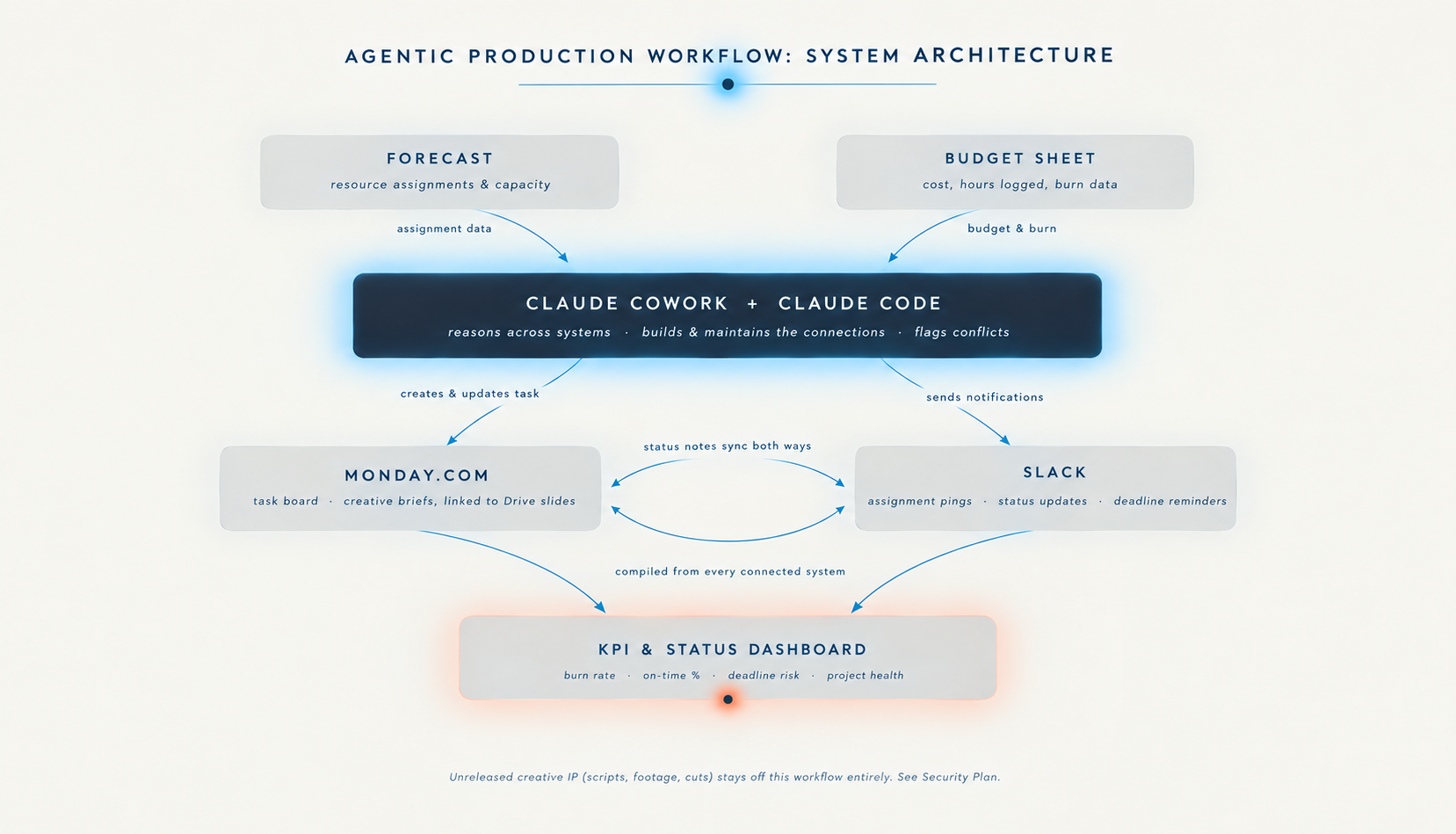
Diagram showing resourcing and budget data flowing into a central AI reasoning layer, which then syncs with a task board and team chat, and compiles a combined KPI and status dashboard.
The goal was never to introduce another platform. It was to connect the ones already in use, and add a layer of reasoning on top. An assignment made once shows up everywhere it needs to, within minutes. Creative notes reach the right person directly instead of waiting to be noticed. Budget and burn data compile continuously, so risk surfaces while there's still time to act on it. Each system stays the source of truth for its own data. The AI layer moves information between them and reasons about what matters which is the practical difference between a notification rule and an agentic workflow.
Built to Earn Trust First
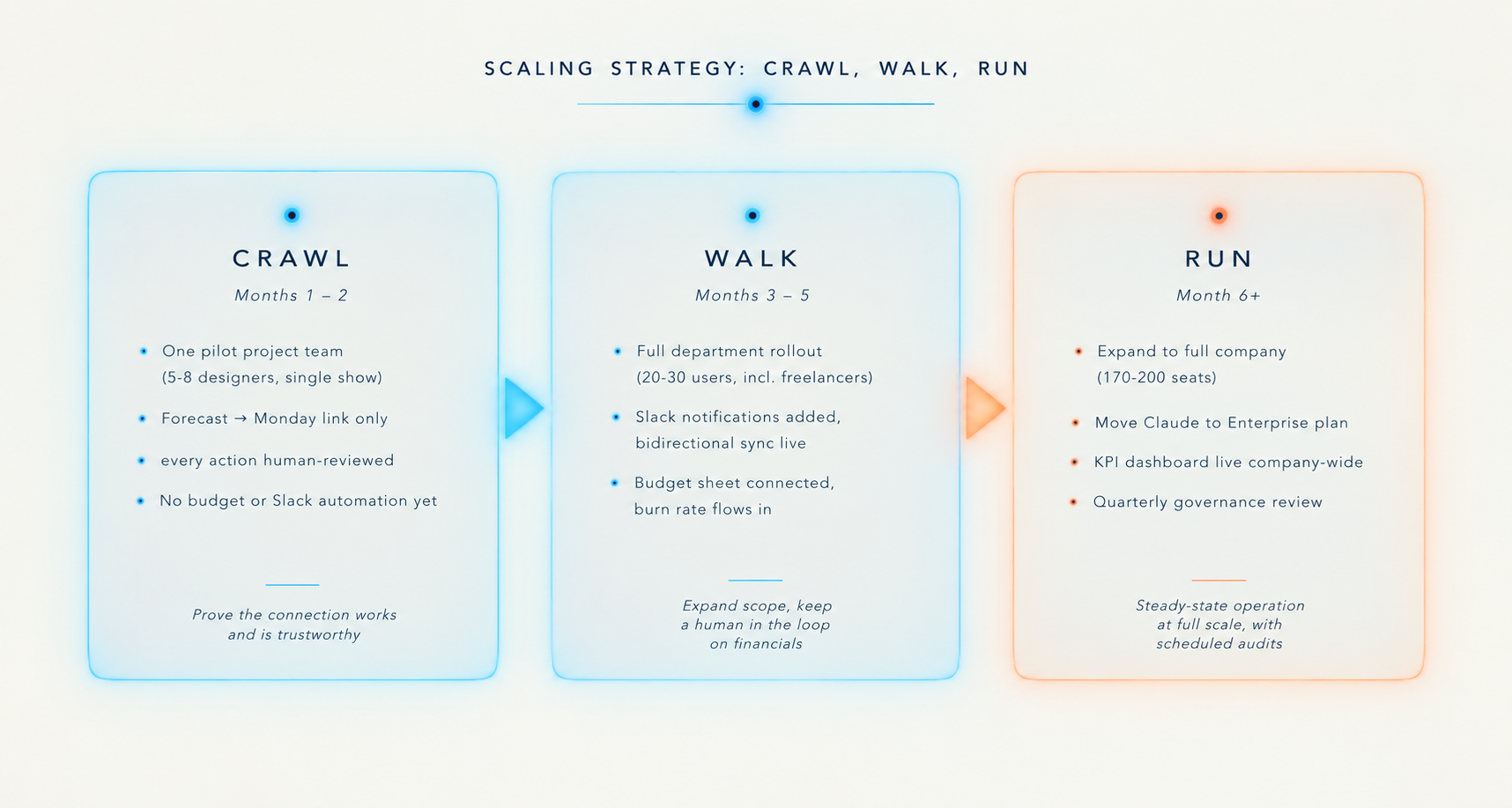
New systems fail when they arrive all at once. This one expands in three phases, and each phase only widens after the last one proves reliable and the team actually trusts it. It starts with a single project team and one connection. It ends at full company scale with a live dashboard and quarterly governance reviews. Adoption is the metric that gates each step not the calendar.
Scope and automation expand only after each phase proves reliable.
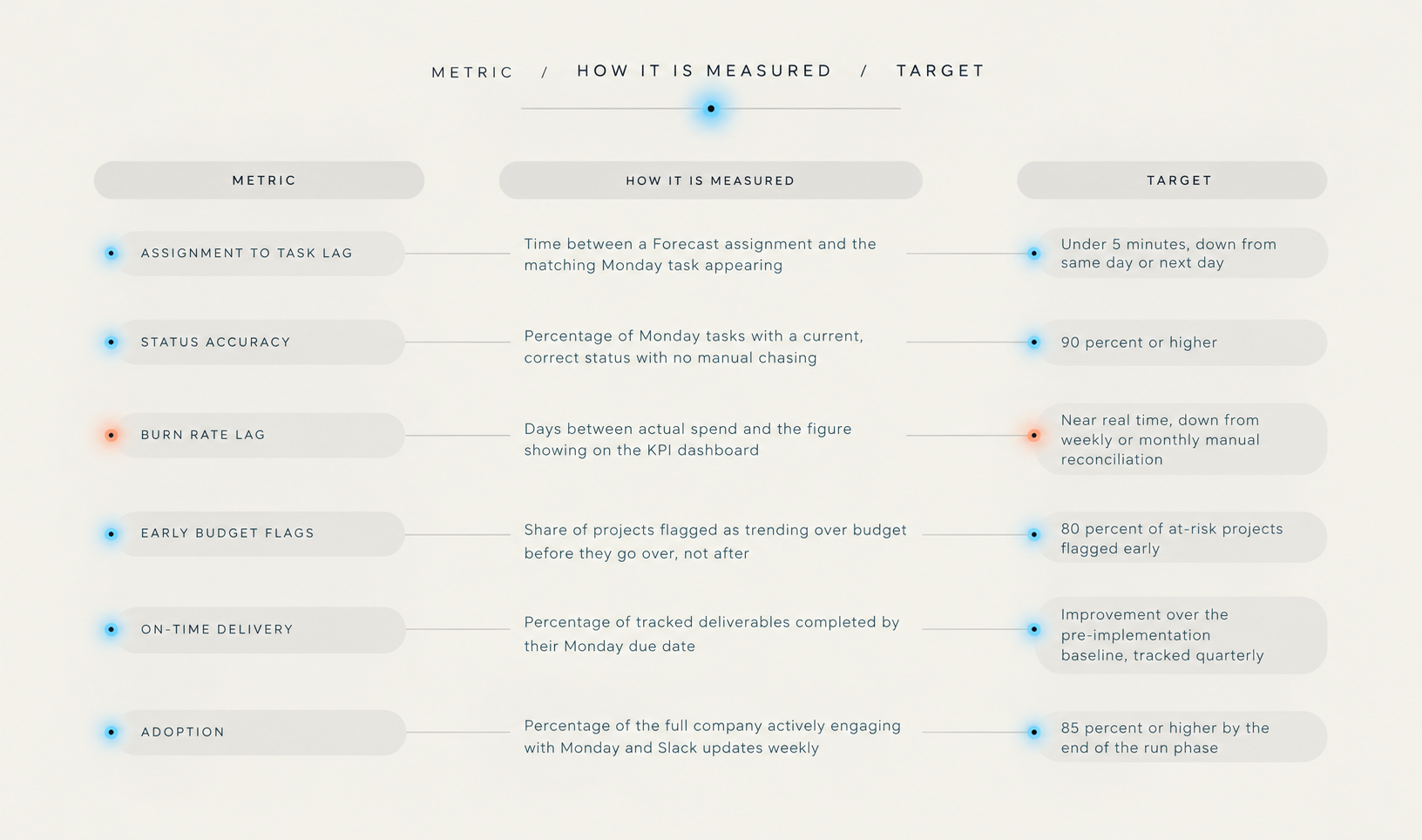
Success is measured on speed, accuracy, and adoption: how fast an assignment becomes a task, how current statuses stay without chasing, how quickly spend data surfaces, how early budget risk is caught, and whether the team actually uses it. Adoption sits alongside the operational metrics deliberately a connected system that people ignore hasn't worked.

WORKFLOW CONTEXT
·
TECHNOLOGY CHOICE
·
STRATEGY DESIGN
·
COST CONSIDERATIONS
·
SECURITY PLAN
·
CHANGE MANAGEMENT TRAINING
·
SCALING STRATEGY
·
GOVERNANCE AND COMPLIANCE
·
KEY PERFORMANCE INDICATORS
WORKFLOW CONTEXT · TECHNOLOGY CHOICE · STRATEGY DESIGN · COST CONSIDERATIONS · SECURITY PLAN · CHANGE MANAGEMENT TRAINING · SCALING STRATEGY · GOVERNANCE AND COMPLIANCE · KEY PERFORMANCE INDICATORS
KPI Table
Table of key performance indicators including assignment-to-task lag, status accuracy, burn rate lag, early budget flags, on-time delivery, and adoption rate, each with a measurement method and target.
Beyond the workflow itself, the plan covers the parts teams tend to discover too late data access and vendor risk, guild and jurisdictional considerations, change management, and the KPIs that make adoption measurable rather than assumed.
Happy to walk through the full plan, or talk about what this would look like inside your systems.
Throughline of Ella’s Work style

Ella has completed MIT’s Applied Agentic AI for Organizational Transformation